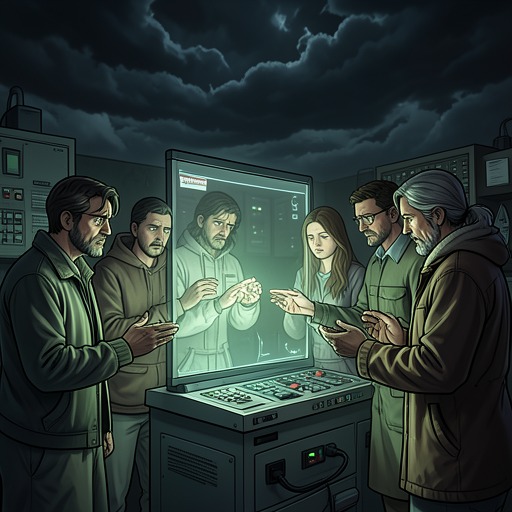
70MB safe-transfer limit
The Old AxolotlThe 70MB safe-transfer limit is a practical rule for transformer communication in a world where transferring mind-related data may expose a machine to the Plague. Established by trial and error rather than a known account of the infection’s nature, it offers a narrow assurance: files smaller than 70MB were considered safe, but the threat behind the boundary remained unresolved.
Origin and Scope
The limit arises from the problem of trusting another person’s hardware. In the conversation surrounding it, the possibility is raised that a soul might become stuck in the wires rather than pass through the IS, with no model or template person available for comparison. The uncertainty is not merely whether a connection works, but whether something has crossed over intact—or whether a hostile process has entered the mind in its place.
The Plague’s nature had still not been determined, so transformers relied on an empirical threshold: files below 70MB did not risk infection. The rule therefore marks a tested zone of relative safety, not a complete explanation of how infection occurs. It narrows the danger without resolving it.
Connection Practices and Risk
The precautions take place within a broader etiquette of connection. Frances Rory manually enters an IP address and a long RioBit secure connection protocol code, then invites SoulEater39 to check the connection. The sequence makes trust concrete: access depends on deliberate technical steps and on accepting another system’s hardware, rather than on an abstract assurance that communication is harmless.
The 70MB boundary permits only limited online activity. Transformers can safely emote from Google, but little else besides. The distinction matters: the rule does not make unrestricted transfer safe, nor does a successful connection abolish the risk. It governs what can cautiously be done within a connection whose dangers are still only partly understood.
Limits of the Rule
The threshold must be read alongside a separate restriction: transformers do not upload themselves directly onto robot processors. Those processors are too weak to handle an entire neurosoft at IS3 transformation standard. Instead, a transformer opens a hard link with a robot, receiving one-millisecond feedback. Even this more limited arrangement was not harmless in practice; many transformers mashed themselves irretrievably during the first days after the Extermination.
That history makes the safe-transfer limit a bounded safeguard, not a promise against every kind of failure. The 70MB figure concerns infection risk from files; the account of damaged transformers concerns the broader hazards of connecting minds and machines. The distinction prevents the rule from being mistaken for a general guarantee of safe embodiment or communication.
A Networked World
The rule’s caution sits within a setting where intelligence and agency are distributed across networks and material systems. The irigotchi, originally cuddly toys whose processors learned from individual children, formed herds after the Extermination and modified their shared neuro-structure without human beings. Later, their vectors spread across networked matter on the Charles River, arranging leaves and branches into fractal patterns and then beginning again on Mothernet surfaces when Bartek blew their work away.
The larger networks also blur the boundary between person, program, and collective. Bartek cannot say whether Lady Spiro comes from a humano-transformer mixture, a long-lived vector of the Matternet, or managerial software; she does not know herself either. Against this background, the 70MB limit is more than a transfer specification. It is a modest attempt to draw a safe boundary in a world where minds, machines, and network processes increasingly overlap, even as the nature of the danger—and sometimes of the communicating entity—remains uncertain.